

Shedding a few months after stress, illness or a run of poor sleep usually settles on its own, and the hair grows back. Pattern hair loss is different: it progresses slowly in a typical pattern and does not grow back by itself.
Knowing which one you have tells you whether to wait it out or see a specialist. This article explains how each type behaves, the signs that need a doctor, and where a hair transplant fits in.
Can stress and poor sleep really make your hair fall out?
Yes, a major strain on the body or mind can do it. It can push many hairs into their resting phase at the same time, and a few months later those hairs fall out together.
Doctors call this temporary shedding telogen effluvium. Common triggers include a high fever or illness, surgery, childbirth, sudden weight loss and a period of intense emotional stress.
The link with sleep is less clear-cut. Poor sleep is not usually named as a direct cause on its own. But it often comes alongside stress and illness, and it can make recovery from both harder.
The delay is what catches people out. Because the shedding begins weeks or months after the trigger, the connection is easy to miss.
How can you tell temporary shedding from pattern hair loss?
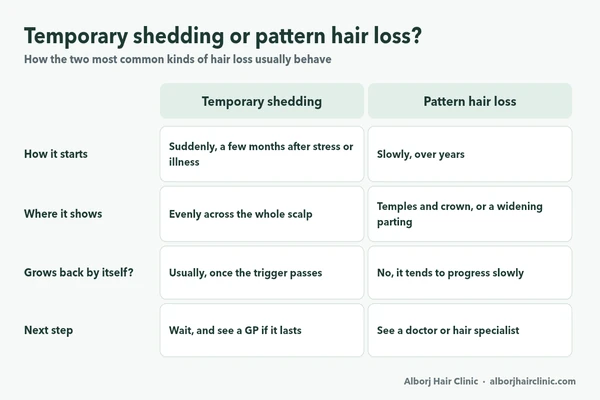
The two look quite different once you know what to watch for. Temporary shedding thins the whole scalp evenly, while pattern hair loss follows a recognisable shape.
| Temporary shedding | Pattern hair loss | |
|---|---|---|
| How it starts | Fairly suddenly, often a few months after a trigger | Gradually, over years |
| Where it shows | All over the scalp, with more hair in the brush or shower | Temples and crown in men; a widening parting in women |
| Does it grow back? | Usually, once the trigger has passed | Not by itself |
| Who to see | A GP if it lasts or worries you | A doctor or hair restoration specialist |
Pattern hair loss is graded on the Norwood scale in men and the Ludwig scale in women, which has three grades. These scales help a specialist judge how far thinning has gone.
How long does stress-related shedding take to settle?
Temporary shedding often starts around two to three months after the trigger. It usually eases within a few months once the body has recovered.
Regrowth then takes patience, because hair grows slowly. New hairs come through short, so it can be several more months before your hair feels as full as it did.
- Look after the basics. Regular meals, enough rest and steady routines support your general recovery.
- Be kind to your hair. Avoid tight styles and harsh treatments while it is shedding.
- Keep a note of dates. Writing down when the shedding began, and any recent illness or stress, helps a doctor later.
- Give it time. This kind of shedding usually settles without special products.
Worry about losing hair is understandable. Knowing that this type usually passes can make the wait feel lighter.
When should you see a doctor or specialist about hair loss?
See a doctor if your hair loss does not fit the temporary picture, or if something else feels wrong. Signs worth checking include:
- Shedding that carries on for more than about six months
- Patches of hair loss, smooth bald spots or broken hairs
- An itchy, sore, scaly or red scalp
- Hair loss alongside other symptoms, such as tiredness, weight change or feeling unwell
- Thinning at the temples, crown or parting that keeps slowly progressing
A GP is a sensible first stop, as some causes of hair loss need tests or treatment. A doctor may suggest other options first, depending on what they find.
If the thinning follows a pattern, a hair restoration specialist can assess its stage and explain what is realistic for you.
When is a hair transplant the right option?
A hair transplant is only for stable pattern hair loss. It does nothing for temporary shedding, which usually grows back by itself, and it is not used while the cause is still unclear.
In a transplant, healthy follicles are moved from the back and sides of the head to the thinning area. The DHI (Direct Hair Implantation) method removes them individually with fine punches, then sets each one in place with a hand-held implanter pen. The procedure is done under local anaesthesia.
“Some people who come to see me are worried about shedding that turns out to be temporary. In those cases, the honest advice is to wait. A transplant only makes sense when the pattern is clear and stable, and there is enough donor hair to move.”
Growth after a transplant is gradual too. New hair usually appears at around three months, with the full result at around a year. The surrounding original hair can still thin with age, so the surgeon plans for that.
About Alborj Hair Clinic
Alborj Hair Clinic is a hair transplant clinic in Mazaya Centre, Al Wasl, Dubai. Its surgeon, Dr Dimitrios Ziakas, has 24 years of experience and has performed more than 4,000 hair transplant procedures. He is a member of the International Society of Hair Restoration Surgery (ISHRS) and uses the DHI (Direct Hair Implantation) technique.
You can read more about the clinic and its approach at alborjhairclinic.com.
The same website also has before-and-after case studies from past patients.
Frequently asked questions
Does hair lost to stress grow back?
In most cases, yes. Shedding triggered by stress, illness or a similar shock usually settles within a few months, and the hair regrows gradually.
Can poor sleep cause pattern hair loss?
Pattern hair loss is mainly linked to genes and hormones, not sleep. Poor sleep may be part of a stressful period that triggers temporary shedding, but it does not cause the typical pattern.
Can women have pattern hair loss?
Yes. It usually appears as a wider parting and less volume on top, rather than a receding hairline. Doctors grade it on the Ludwig scale.
Should I have a transplant while my hair is shedding?
No. A transplant is for stable pattern hair loss. If you are shedding, a doctor will usually want to find the cause and see it settle first.
Leave a Comment